If Hillary Clinton Tries to Run Again in 2020 She Should Be Shot on Sight
How Hillary Clinton Became a Postmodern Menace
The quondam presidential candidate is in the news again. Why exercise some find that so troubling?
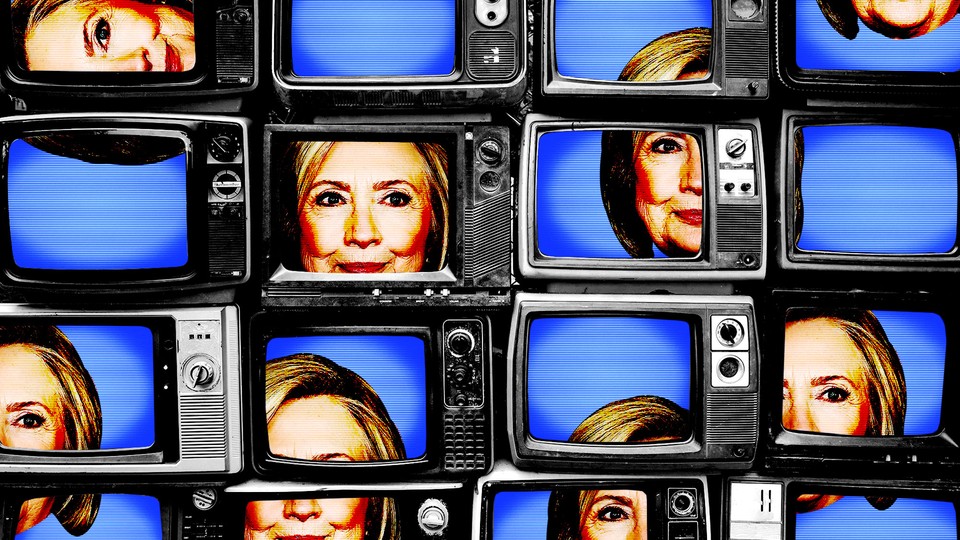
In late January, the Washington Examiner published an unsigned editorial with a plaintive headline: "Why Won't Hillary Clinton Just Become Away?"
The paper's question was at once timely—Clinton, that week, had been making media appearances for the premiere of the Hulu docuseries Hillary—and timeless. It is the aforementioned question that is asked pretty much anytime Clinton is in the news again, which is to say very frequently, expressed through headlines like "The Real Reason Hillary Tin can't Just Shut the Fuck Up and Get Abroad" and "Hillary Clinton Only Won't Go Away"—and through arguments similar "Hey, Hillary Clinton, shut the f--- upward and go away already." Nanette Burstein, Hillary'southward managing director, told my colleague Shirley Li that one of the many reactions she'd been anticipating to the documentary earlier its release was "Please get away." She had adept reason to expect that. There aren't many certainties in this world; one matter you can depend on, yet, is the fact that, at nearly whatsoever moment, someone is punctuating a post on Facebook or Twitter or Instagram with a #GoAwayHillary hashtag.
The vitriol is revealing. Bill Clinton has been part of the national chat for precisely every bit long as his wife has, but Americans have not spent years publicly expressing their want for him to disappear. Nor accept cottage industrialists spent years producing "Get Abroad Bill" merch (T-shirts, hoodies, coffee mugs) to monetize the ire. It is Hillary, uniquely—a trivial bit Rorschach, a piddling scrap Rashomon—who rankles people. It is Hillary who is imagined, by many in the American public, as a conspiracy theory incarnate.
And it is Hillary, in that sense, whose treatment as a living fiction is timely even so again, during a Democratic primary that found a large group of capable and electorally feasible female candidates steadily eliminated from contention. (#DropOutWarren may take its own electoral particularities; it is also spiritually like to #GoAwayHillary.) Presidential politics will always involve some strains of magical thinking. Women candidates, though, often inspire something more akin to paranoia. They are often treated as interlopers, their presence regarded, in ways both subtle and astoundingly obvious, as an encroachment. American culture talks a big game when information technology comes to women'southward equality, just it has not, traditionally, been terribly expert at following through on the slogans. And Hillary Clinton—who won in 2022 but as well very much didn't—is a reminder of the depth of the lie. That might help to explain why and so many people would prefer that she cease doing the reminding.
The month was Feb, and Sean Hannity was doing what Sean Hannity and then ofttimes does: delivering, to his millions of viewers, an indignant speech about Hillary Clinton'southward emails. This particular screed was notable for the graphic that accompanied it—CLINTON SERVER SCANDAL, information technology went, against a dizzying properties of 1'south and 0'southward—only it was fifty-fifty more than notable for its appointment: February … 2020. Clinton, past that point, had long been cleared of any wrongdoing related to her State Department electronic mail server, and had returned to her condition as a private denizen.
In Fox'south preferred cosmology, however, Clinton remains in power—not in the presidency, just as a figure of postmodern menace. On its air, equally in many other outlets, she has become a grapheme about whom annihilation might be true, fifty-fifty if the thing, strictly speaking, makes no sense. Is she roofing up a chronic illness? Did she murder Vince Foster? Is she hiding the body of a reptile under all those colorful pantsuits? Who can say? (The answer, apparently, is that Sean Hannity tin can say: In September 2019, Media Matters reported that he had mentioned Clinton in 505 of the 587 episodes of his prove since the outset of Donald Trump'southward presidency. If the number of mentions included Hannity'south guests, the total Clinton invocations jumped to 536.)
There is ane very simple answer to the question of "Why won't Hillary become away?": Many people don't desire her to. Their hatred of her is lucrative. It is likewise expedient: Casting her as a thing rather than equally a person, information technology is freed of the need to retrieve that a human is on the other cease of it. A 2016 Washington Post story virtually Clinton's time every bit starting time lady included a telling anecdote. A staffer of Clinton's in one case read aloud from a mag article that repeated one of the many rumors that swirled around her: that Clinton had had sex with a colleague. Hearing it, or rather mishearing it, the Post's Marc Fisher reported, "Clinton's optics filled with tears." She asked the staffer, "It really says I had sex activity with a collie?"
Burstein's docuseries is an answer to that sort of conspiracism. Hillary evinces a notable cheeriness. Each of the show's four episodes begins with a quick-cut montage of even so images from Clinton'southward life set up to the Interrupters' frenzied canticle "Have Back the Ability." ("What'south your programme for tomorrow?/ Are yous a leader, or will y'all follow?/ Are you a fighter, or will you cower?/ It's our time to have back the power.") What follows are interviews with old friends and colleagues and, often, moments of macabre humour. (Someone once asked what she wanted written on her gravestone, Clinton says at one signal. Her reply: "She's neither every bit practiced nor equally bad as some people say about her.")
Early on, though, Hillary makes clear that information technology volition go beyond complicating the caricature of Clinton, and beyond placing Clinton within the history of American feminism. The series does something both more basic and more revealing than whatsoever of that: It argues for Clinton'due south humanity. It offers a reminder that Clinton is a person—with a human body and a human center—to the many who are inclined to forget. Decades of life in the public eye have made the motion-picture show's subject area a very good educatee of herself. "I know that I can be perceived as aristocratic or cold or unemotional," Clinton has said, "but I had to learn as a young woman to control my emotions. And that's a hard path to walk. Because you need to protect yourself. You need to keep steady. Only at the same fourth dimension you don't want to seem walled off."
"Actuality," with all its unanswerable demands, hovers over Hillary. The film features several shots of her getting her hair and makeup done, and several other moments of her discussing the shots of her getting her pilus and makeup done. ("I calculated information technology, and I spent 25 days doing hair and makeup," she says of the 2022 presidential entrada, laughing.) Burstein's camera is also intimate in its sweep: Information technology is at that place to grab a scene of Hillary and her husband on a plane, he reading and she sleeping. She'due south holding his arm in her easily. It'south at that place to capture some other scene on a plane: one in which Hillary is reading Elizabeth George's novel A Feast of Consequences. (Another novel written by George, one can't help but note, is The Penalisation She Deserves.) It's there to capture the moment on Super Tuesday of 2016, when Hillary and her staffers get word of usa she has swept and call Bill to relay the news: "Nosotros just wanted you to share in our hysteria!" she shouts, gleefully.
Clinton'southward interviews with Burstein (who does not appear on photographic camera) suggest a similar sort of openness. She addresses the conventional wisdom that she is bad at candidature by explaining that she doesn't want to promise something she can't evangelize: "I don't like to say something that I know is non truthful," she says, contra decades' worth of media assessments of her. "I don't want to say I'll do something that I know is undoable. That is merely anathema to me."
At another indicate, she says of the media'due south treatment of her, "I couldn't figure out, y'all know, what is it they wanted from me?" The line has echoes of the indignation that pulsed through Clinton's frankly titled 2022 memoir, What Happened. "What more do you need?" she asks in it.
Other women in politics might ask similar questions—particularly at this moment. Hillary Clinton is a very different candidate from, for instance, Elizabeth Warren, Amy Klobuchar, or Kamala Harris. Her handling, though, foreshadowed what the other women would face up as they made bids for the presidency in 2020. "She is especially poor at the podium," the columnist Peggy Noonan argued in 2016, "where, when she wants to emphasize an applause line, her voice becomes loud, flat, and harassing to the ear." Andrea Tantaros, and so a host at Fox, likened Clinton to a "thoroughbred horse" who is "on her manner to the mucilage factory."
These were echoes of assessments that had been lobbed at Clinton when she was first lady. Just after the 1992 election, a encompass of Spy mag superimposed Clinton'south head onto the body of a dominatrix, the composite figure posing in the Oval Office. The New York Mail service ran a cartoon featuring Bill Clinton equally a marionette—with Hillary pulling his strings. The American Spectator called Hillary the "Lady Macbeth of Little Stone." Barbara Amiel, of Maclean's, declared that "the kickoff lady has emasculated America" and compared Hillary to Lorena Bobbitt.
The philosopher Kate Manne argues that sexism is best understood not as an private trait, but rather as an credo—one that is intent on limiting women's advancement and power. This theory is particularly relevant in Clinton'due south example. "Why won't Hillary go abroad?" is, after all, a milder version of that Trumpian standby: "Lock her up!" The question might suggest political strategy or psychological ennui. What it besides suggests, though, is that Hillary Clinton intruding into a space where she does not belong. It suggests a frame of mind in which Joe Biden runs for president three times because that is his correct—but in which Hillary Clinton runs for president twice because she doesn't know when enough is enough.
Almost independently of Clinton's particular politics, her fourth dimension in the public eye has often doubled equally a alarm to other women: This is what might happen to y'all. This is how y'all will be treated. It predictable the mistreatment of Michelle Obama. It anticipated the mistreatment of Katie Hill. Information technology anticipated the mistreatment of Alexandria Ocasio-Cortez. It anticipated the mistreatment of Elizabeth Warren. "The past is never dead," the line goes. "It's not fifty-fifty by."
No wonder so many people—even people who once counted themselves every bit her fans—would prefer that Clinton simply disappear. No wonder the reaction to her continued presence is so visceral and aroused. The thing is not merely that Americans have a addiction of treating older women as inconvenient and invisible and expendable. Information technology is also that Clinton herself—the very persistence of her presence—is a reminder of all the progress that wasn't. She is a reminder of how possible it is, in the America of the present moment, to win and lose at the same fourth dimension. And she is a reminder of how piece of cake it is, in a culture that celebrates "elder statesmen" but prefers to ignore their counterparts, to overstay one's welcome.
Source: https://www.theatlantic.com/culture/archive/2020/03/why-hillary-clinton-wont-just-go-away/607852/
0 Response to "If Hillary Clinton Tries to Run Again in 2020 She Should Be Shot on Sight"
ارسال یک نظر