Chavin De Huantar 900200 Bce Ap Arts Great Serpent Mound 1070 Ce Ap Arts
-
Consummate Identification:
-
Not bad Serpent Mound
-
Unknown artists
-
Earthwork/effigy mound
-
c. 1070 C.East.
-
Adams County, Ohio (created by Fort Aboriginal peoples of the Middle Ohio River Valley)
-
Remains in original location.
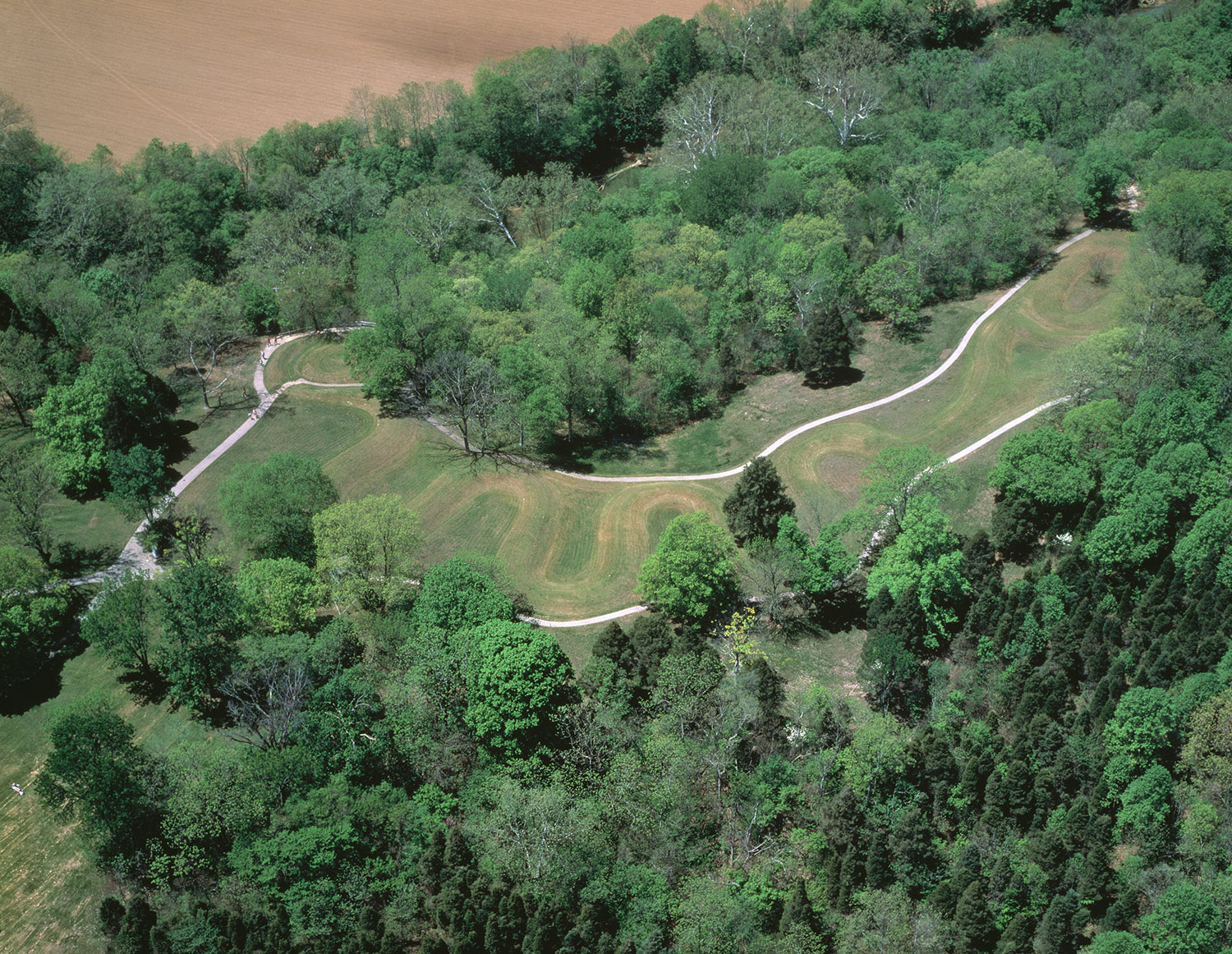
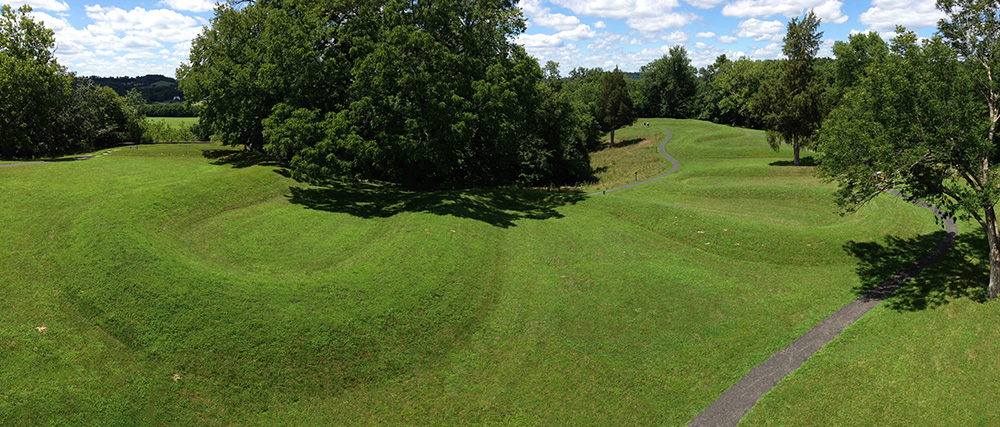
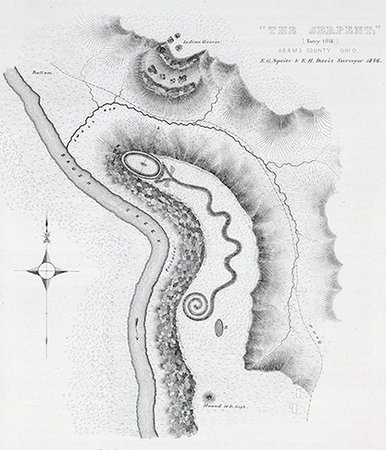
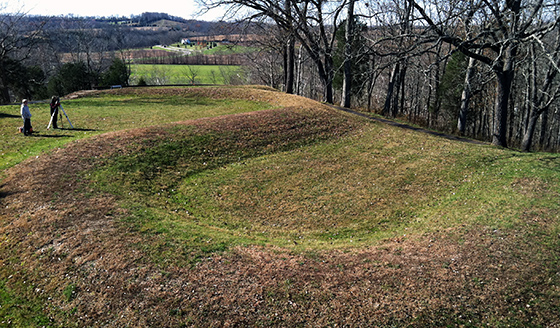

Function:
-
Snakes, which were seen to accept supernatural powers, were ofttimes incorporated into spiritual rituals.
-
The astrological alignment of the serpent—the head aligns with the summer solstice sunset and the tail with the winter solstice sunrise—suggests that it was used to mark the seasons. Similarly, the curves in the serpent'south body may follow lunar phases or equinoxes.
-
Information technology's possible that the snake is swallowing the ovoid shape at its head, which could represent the sun. Mayhap the swallowing of the sun was meant to document a solar eclipse.
-
The direction of the (North) Pole Star aligns with the commencement curve of the serpent from its caput; thus the ophidian may have served as a natural compass. Information technology also may take represented the constellation Draco, which included the Pole Star.
-
Created around the same time that Haley's Comet appeared—may have marked this astronomical event.
-
Although burial sites from the earlier Adena civilization nearby point a possible burial purpose for the serpent, no archaeological bear witness suggests this.
-
Scholarly debate over the mound'south purpose (conspicuously) continues.
Context:
-
Created by Native American tribes (primarily the Fort Ancient culture) who lived in the valleys of the Ohio, Missouri, Mississippi, and Illinois rivers earlier settlers of European descent came to the region in the 19th century.
-
The people who made this mound lived in settled agrestal communities; farmed squash, maize, and beans (the "iii sister" crops); had a stratified social hierarchy with a big labor force, and did non leave behind written records.
-
Figure mounds of animal figures were common creations of the tribes of the Upper Midwest; however, many of these mounds were destroyed by the plows of European settlers.
-
Many of these cultures believed snakes to have supernatural powers; tribes of the Middle Ohio Valley oft made copper serpentine figures as well.
-
Geography: the mound follows the topography of a high plateau over Ohio Brush Creek—the serpent's head points to a cliff overlooking the creek. It's speculated that the plateau's lizard similar shape evoked (and inspired?) the cosmos of the serpent.
-
Geology: a meteor struck the site 250-300 mya, creating folded bedrock.
-
The Fort Ancient peoples lived in densely populated agrestal villages of 100-500 residents, composed of circular or rectangular houses surrounding an open up plaza.
-
In addition to agronomics, some members seasonally lived and traveled in hunting groups, supplementing their nutrition with deer, elk, turkey, acquit, minor game, nuts, fruits, and berries.
-
During this period (after g A.D.), the civilisation shifted from making burying mounds to cemeteries surrounded by trash and storage pits.
-
The Fort Ancient culture lived contemporaneously alongside the Mississippian culture, which built Cahokia and heavily emphasized the theme of the rattlesnake. It'due south possible that this serpent mound is a testament to the influence of the Mississippian rattlesnake-worshipping practices.
-
Some scholars consider the Fort Ancient civilisation only to be an offshoot of the Mississippian civilisation.
-
Perhaps the mound is just a restoration/refurbishment of an earlier mound made by the Adena civilization (c.1100 B.C.Due east.-200 C.E.) or the Hopewell civilisation (c. 100 B.C.E.-550 C.E.).
-
Form:
-
Dirt
-
Ophidian figure mound, the largest 1 in the earth, over 1300 feet long. An average height of 4-5 feet and an boilerplate width of xx-25 anxiety.
-
Thought to possibly be a rattlesnake
-
Depicts a snake with three curves and a tail ending in a spiral that appears to b swallowing a circular shape.
-
The mound conforms to the natural topography of the area
-
The caput faces eastward and the tail faces west
-
Head aligns with summer solstice sunset
-
Tail points to the winter solstice sunrise.
-
Erected c. 1070, although the construction date is entirely speculation and no one, is completely sure of it
-
Is a national historic landmark
Content:
-
A snake, slightly crescent-shaped
-
With the snake's head to the east and the tail to the due west
-
The ovoid shape at the eastern terminate of the serpent is thought to be its head, eye, or possibly an egg or even the sun that the ophidian is swallowing (representing a solar eclipse?)
-
Depicts a large snake, peradventure a rattlesnake
-
Many Native American cultures east of the Mississippi believed the snake to be a powerful deity of the underworld.
Vocabulary:
-
Effigy: a model or sculpture
Cross-cultural comparisons:
-
Stonehenge
-
Aligning dissimilar parts of the structure with solstice/ equinox and connection to angelic cycles.
-
Both very large structures that would have required an organized plan and innovative methods to be made.
-
Apollo 11 stones
-
Are both very basic depictions of animals (detail wise)
-
Both accept very ambiguous and unknown meanings
Themes:
-
Display
-
Power-authorisation; images of the Divine
-
Animals in art
-
Myth
-
Sacred Spaces
Sources:
-
-
https://www.metmuseum.org/toah/hd/serp/hd_serp.htm
-
https://www.ohiohistory.org/visit/museum-and-site-locator/serpent-mound
-
https://world wide web.khanacademy.org/humanities/ap-art-history/ethnic-americas/a/fort-ancient-civilization-great-serpent-mound
-
https://www.fortancient.org/archaeology/ohio-pre-history?showall=&start=v
-
http://www.ohiohistorycentral.org/w/Fort_Ancient_Culture
-
https://www.metmuseum.org/toah/hard disk drive/serp/hd_serp.htm
-
http://world wide web.ohiohistorycentral.org/west/Serpent_Mound
Source: https://sites.google.com/site/adairarthistory/v-indigenous-americas/156-great-serpent-mound
0 Response to "Chavin De Huantar 900200 Bce Ap Arts Great Serpent Mound 1070 Ce Ap Arts"
ارسال یک نظر